
Whirlpool Washer Not Spinning?
One of the most common Whirlpool washer problems is a washer that won’t spin properly. When this happens, clothes often come out soaking wet because the washer cannot remove excess water during the final spin cycle.
Washer Won’t Spin? Don’t Replace Parts Yet
The good news is that many spin-related issues can be diagnosed without immediately replacing expensive parts. In some cases, the problem may be as simple as an unbalanced load, while in others it may involve a failed lid lock, shift actuator, drive belt, motor, or control board.
This guide explains the most common causes of a Whirlpool washer not spinning and the components you should inspect first.
Common Causes of a Whirlpool Washer Not Spinning
A Whirlpool washer depends on several mechanical and electronic components to complete the spin cycle. When one of these parts fails, the washer may stop spinning, spin at reduced speed, or leave clothes soaking wet at the end of the cycle.
Understanding the most common causes can help you diagnose the problem faster and avoid replacing unnecessary parts.
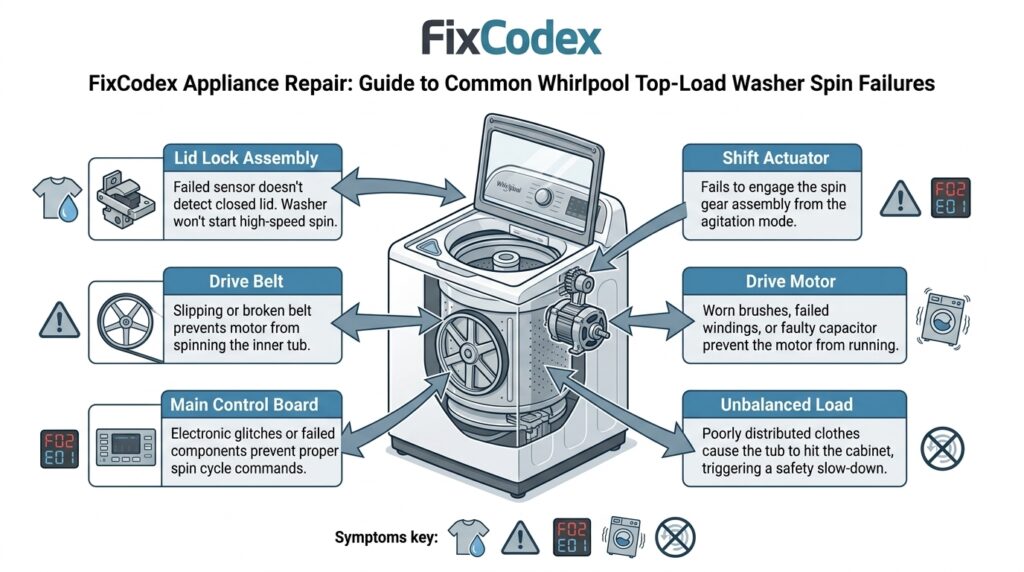
Several components work together during the spin cycle. If any of them fail, the washer may stop spinning altogether or spin very slowly.
1. Faulty Lid Lock Assembly
Most modern Whirlpool top-load washers will not spin unless the lid lock engages properly. This safety feature prevents the lid from opening during high-speed spinning.
Common symptoms include:
- Washer fills and washes normally
- Spin cycle never starts
- Lid lock light flashes
- Clicking sounds near the lid
If the lid lock fails, the control board may prevent the spin cycle from operating.
2. Failed Shift Actuator
The shift actuator changes the washer between agitation and spin modes.
A defective actuator may cause:
- No spin cycle
- Agitation problems
- Grinding noises
- Error codes such as F7E1
This is one of the most frequently replaced components on Whirlpool top-load washers.
3. Worn or Broken Drive Belt
Some Whirlpool washers use a belt to transfer power from the motor to the transmission or drive system.
A worn belt may cause:
- Weak spinning
- Burning rubber smell
- Squealing noises
- Basket not reaching full speed
Inspect the belt for cracks, glazing, or excessive wear.
4. Defective Drive Motor
The drive motor powers both agitation and spinning functions.
A failing motor may result in:
- No spin cycle
- Humming noises
- Intermittent operation
- Washer stopping mid-cycle
Motor testing usually requires a multimeter and service documentation.
5. Malfunctioning Control Board
The main control board coordinates all washer functions, including spinning.
If the board fails, you may notice:
- Random cycle interruptions
- Washer stuck on sensing
- Frequent error codes
- No response during spin commands
Before replacing the control board, verify that other components are functioning correctly.
6. Unbalanced or Overloaded Load
Not all spin problems are caused by failed parts.
An overloaded washer may:
- Stop before spinning
- Display an error code
- Shake excessively
- Redistribute clothes repeatedly
Try removing some items and running a spin-only cycle.
Whirlpool Error Codes Related to Spin Problems
Many Whirlpool washers display diagnostic codes when spin-related components fail.
Common examples include:
F7E1 – Basket Speed Fault
The washer cannot detect proper basket movement during spinning.
Possible causes:
- Failed shift actuator
- Worn drive components
- Motor issues
- Wiring problems
F7E6 – Motor Fault
The control board detects abnormal motor operation.
F7E5 – Shifter Fault
Often indicates a defective shift actuator or wiring issue.
Need help identifying a specific fault code? Check our Complete Whirlpool Washer Error Code List to find detailed explanations, common causes, and troubleshooting steps for Whirlpool washer diagnostic errors.
Consult your washer’s technical sheet for model-specific code definitions.
Troubleshooting a Whirlpool Washer That Won’t Spin
If your Whirlpool washer won’t spin, a systematic troubleshooting process can help identify the cause before you spend money on replacement parts. Start with the simplest checks first, such as load balance and lid lock operation, then move on to diagnostics and component inspections.
These steps can often pinpoint the problem quickly and save time during repairs.
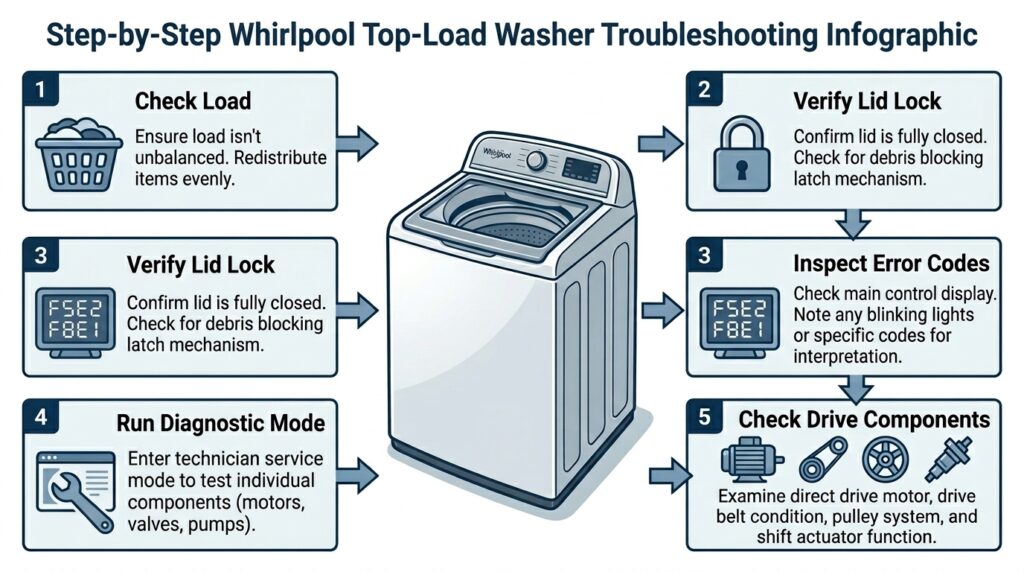
Before replacing any parts, follow these basic troubleshooting steps.
Step 1: Check the Load
Ensure clothing is evenly distributed inside the basket.
Step 2: Verify the Lid Lock
Listen for the lock engaging when the spin cycle begins.
Step 3: Inspect for Error Codes
Record any fault codes displayed on the control panel.
Step 4: Run Diagnostic Mode
Many Whirlpool washers include a built-in diagnostic test mode.
Step 5: Check Drive Components
Inspect belts, pulleys, actuators, and motor connections.
Common Parts to Check
When diagnosing a Whirlpool washer that won’t spin, start with these components:
Lid Lock Assembly
Prevents spinning if the lid is not securely locked.
Shift Actuator
Switches the washer between wash and spin functions.
Drive Belt
Transfers motor power to the drive system.
Drive Motor
Provides the power needed for spinning and agitation.
Main Control Board
Controls all washer operations and cycle sequencing.
If you suspect the main control board is causing spin cycle issues, read our guide on Whirlpool Washer Control Board Problems to learn the common symptoms, testing procedures, and replacement considerations.
🎥 Watch: Whirlpool Washer No Spin Fix
If your Whirlpool washer fills, agitates, and drains normally but refuses to spin, the problem may be simpler than you think. In this helpful video from Word of Advice TV, you’ll learn how a faulty shift actuator can prevent the washer from switching into the spin cycle.
The video walks through the symptoms, diagnosis process, and step-by-step replacement procedure, making it a valuable resource for DIY repairs on Whirlpool, Maytag, Kenmore, and Roper washers with a similar design.
Can a Whirlpool Washer Be Reset?
Sometimes a software glitch can interrupt the spin cycle.
Try this reset procedure:
- Unplug the washer.
- Wait one minute.
- Plug it back in.
- Open and close the lid six times within twelve seconds.
If the issue persists, further diagnosis may be required.
A Whirlpool washer that won’t spin can be caused by several different issues, ranging from a simple unbalanced load to a failed lid lock, shift actuator, drive motor, or control board. Checking error codes and inspecting common failure points can help you identify the problem faster and avoid replacing unnecessary parts.
If your washer consistently fails to enter the spin cycle, start with the lid lock and shift actuator, as these are among the most common causes of spin-related problems in Whirlpool top-load washers.
View more Whirlpool washer problems here.
Related Articles
- W11578565 Whirlpool Washer Control Board: Troubleshooting, Symptoms, Replacement Guide, and Compatible Models
- Whirlpool Washer Sd / SUD Error Code – Excess Suds (Complete Guide)
- Whirlpool Washer F9E2 Error Code – Drain Pump System
- Whirlpool Washer Not Draining Water
Affiliate Disclosure: Some links on this page may be affiliate links. If you purchase through these links, we may earn a small commission at no additional cost to you. This helps support our website and keeps our content free.
1 thought on “Whirlpool Washer Not Spinning: Causes, Troubleshooting, and Common Parts to Check”