
A Whirlpool washer that vibrates excessively, shakes violently, or moves across the floor during the spin cycle usually has a problem with the load balance, washer leveling, or suspension system.
In some cases, worn suspension rods, damaged shock absorbers, broken suspension springs, or worn tub bearings can cause severe vibration.
Quick Tip: If the washer still shakes with a balanced load and a level floor, inspect the suspension system.
This guide explains the most common causes of excessive Whirlpool washer vibration, what parts to check, and how to troubleshoot the problem safely.
Quick Answer
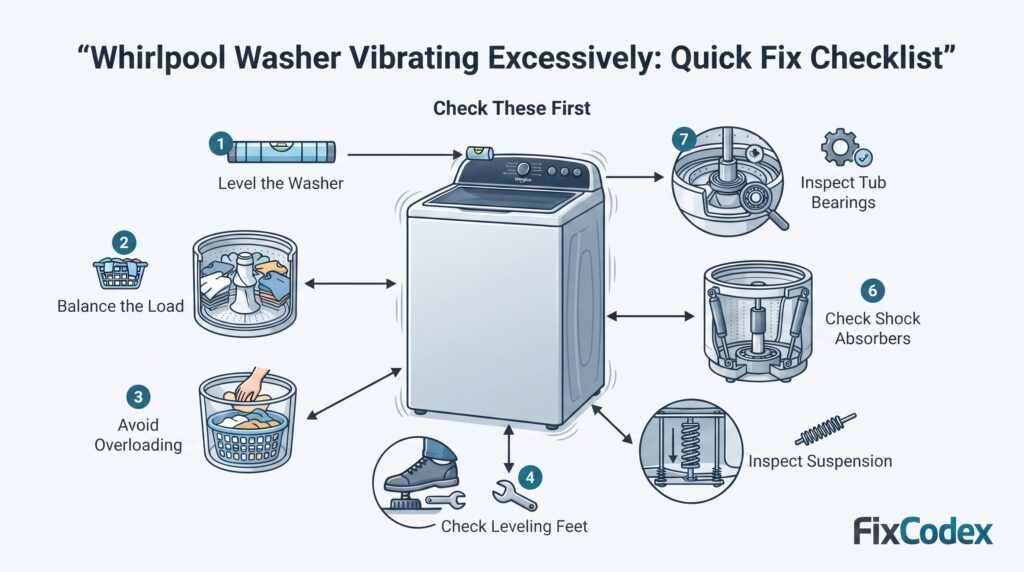
If your Whirlpool washer is vibrating excessively, check these items first:
- Make sure the washer is sitting level on the floor.
- Redistribute clothes if the load is unbalanced.
- Avoid overloading the washer.
- Check and adjust the leveling feet.
- Inspect the suspension rods or suspension springs.
- Check shock absorbers if your washer uses them.
- Inspect the tub bearings for excessive play or noise.
If the washer still shakes violently after correcting the load and leveling the machine, a worn or damaged suspension component may need to be replaced.
Common Symptoms of a Whirlpool Washer Vibrating Excessively
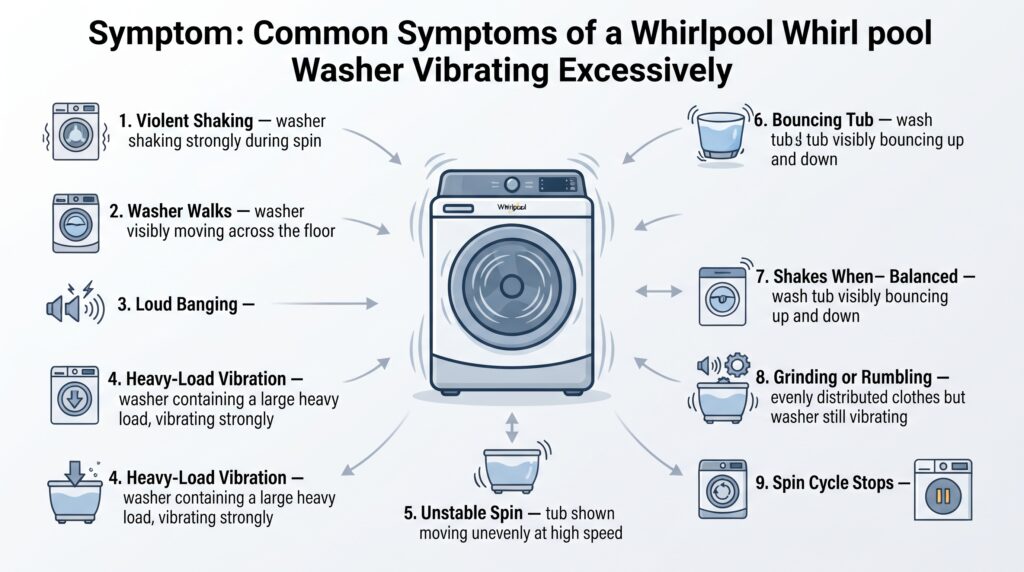
Excessive vibration can appear in several ways:
- Whirlpool washer shakes violently during the spin cycle
- Washer moves or “walks” across the floor
- Washer makes loud banging or knocking noises
- Washer vibrates excessively with heavy loads
- Washer becomes unstable during high-speed spin
- Tub appears to bounce excessively
- Washer shakes even when the load is properly balanced
- Washer makes unusual grinding or rumbling noises
- Washer may stop or interrupt the spin cycle
The specific symptoms can help identify the most likely cause.
1. Unbalanced Washer Load
An unbalanced load is one of the most common reasons a Whirlpool washer shakes during spin.
Large or heavy items such as blankets, towels, comforters, and rugs can collect on one side of the basket. When the washer reaches high spin speed, the uneven weight can cause the tub to move aggressively.
How to Fix an Unbalanced Load
- Stop the washer.
- Open the lid or door when it is safe to do so.
- Redistribute the clothing evenly around the basket.
- Remove some items if the washer is overloaded.
- Add a few similar items if washing a single heavy item.
- Restart the spin cycle.
If the vibration disappears after redistributing the load, the washer may not have a mechanical problem.
2. Washer Is Not Level
A Whirlpool washer can vibrate excessively if it is not sitting level.
The washer should sit firmly on all four feet. If one foot is not making proper contact with the floor, the cabinet can rock or move during the spin cycle.
How to Check the Washer Level
Place a bubble level on top of the washer and check it from side to side and front to back.
Then:
- Make sure the washer is on a solid, stable floor.
- Check each leveling foot.
- Adjust the feet according to the washer’s installation instructions.
- Make sure all feet are firmly contacting the floor.
- Tighten the locking nuts if your model uses them.
- Run a spin cycle and check for movement.
A washer that rocks when you push gently on the corners needs to be leveled before troubleshooting internal components.
3. Worn Suspension Rods
Suspension rods are used on many Whirlpool top-load washers to support and stabilize the wash basket.
Over time, suspension rods and their related components can become worn. When this happens, the tub may bounce excessively during spin.
Signs of Worn Suspension Rods
Common symptoms include:
- Tub bounces excessively
- Washer shakes even with a balanced load
- Basket moves too easily
- Loud banging during spin
- Washer becomes unstable at high spin speed
If the suspension system is worn, replacing the appropriate suspension components may restore normal tub movement.
Always verify the correct part for your specific Whirlpool washer model before ordering a replacement.
4. Damaged or Worn Shock Absorbers
Some Whirlpool washers use shock absorbers to control tub movement.
A worn shock absorber may allow the tub to move too freely. This can result in excessive vibration, especially during the high-speed spin cycle.
Symptoms of Bad Shock Absorbers
You may notice:
- Excessive tub movement
- Strong vibration during spin
- Repeated banging sounds
- Washer moving across the floor
- Vibration that becomes worse with heavier loads
Inspect the shock absorbers for signs of damage, wear, or loose mounting points.
Not every Whirlpool washer uses shock absorbers, so check your model’s parts diagram before attempting a repair.
5. Broken or Weak Suspension Springs
Suspension springs help support the washer tub and control its movement.
A broken, stretched, or weakened spring can cause the tub to sit incorrectly or move excessively.
What to Check
Inspect the suspension springs for:
- Broken coils
- Stretching
- Damage
- Disconnection from their mounting points
- Uneven suspension
If a spring is damaged or disconnected, replace or reinstall it according to the manufacturer’s service instructions.
6. Worn Tub Bearings
Tub bearings allow the basket or tub assembly to rotate smoothly.
When bearings become worn, the washer may produce more than just vibration. You may also hear grinding, rumbling, squealing, or other unusual sounds during spin.
Signs of Bad Tub Bearings
Possible symptoms include:
- Loud rumbling during spin
- Grinding noise
- Excessive basket movement
- Vibration that occurs even with a balanced load
- Water leakage in some washer designs
- Basket has excessive play when moved by hand
Bearing repairs can be more involved than replacing a leveling foot or suspension component. The exact repair depends on the Whirlpool washer model and its tub design.
7. Washer Is Overloaded
Overloading can put additional stress on the suspension system and make it difficult for the washer to balance the load.
Heavy items can also become concentrated on one side of the basket.
What to Do
Follow the load-size recommendations in your Whirlpool washer owner’s manual. Avoid packing the basket too tightly, and give clothing enough room to move freely during washing and spinning.
8. Floor or Installation Problems
Sometimes the washer itself is not the problem.
A weak, flexible, or uneven floor can amplify vibration. A washer installed on an unstable surface may shake more than a washer installed on a solid, level floor.
Check:
- Floor stability
- Washer position
- Leveling feet
- Pedestal or platform, if applicable
- Clearance around the washer
If the washer is on a raised platform, make sure the platform is designed to support the appliance securely.
Whirlpool Washer Excessive Vibration Troubleshooting
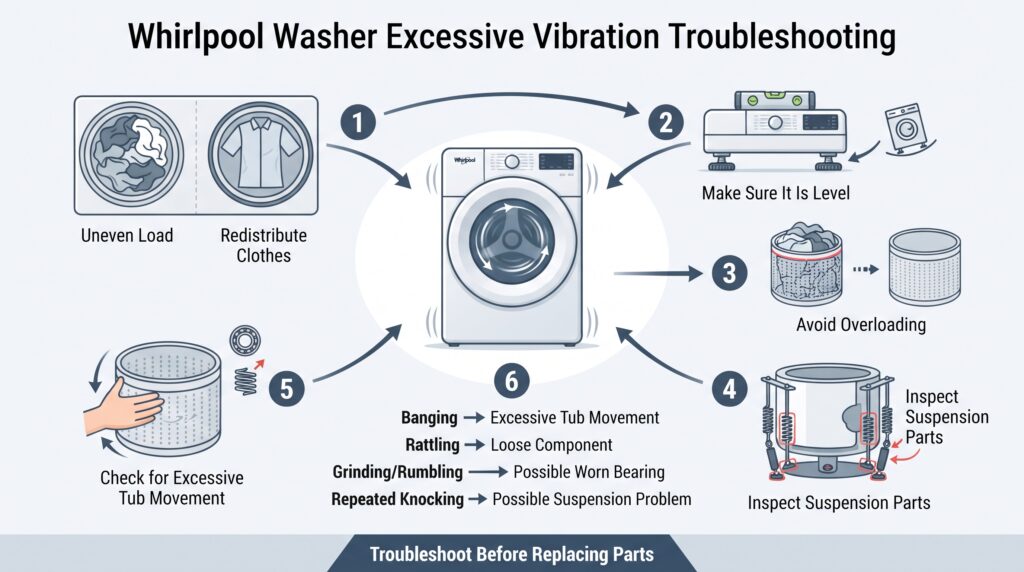
Use this troubleshooting sequence before replacing parts:
Step 1: Check the Load
Stop the washer and redistribute the clothes.
If the washer stops vibrating excessively, the problem was likely an unbalanced load.
Step 2: Check the Washer Level
Push gently on the washer’s corners.
If it rocks, adjust the leveling feet until the washer sits firmly.
Step 3: Check for Overloading
Remove some clothing if the basket is packed too tightly.
Large loads should be distributed evenly.
Step 4: Inspect the Suspension System
If the washer continues to shake with a balanced load, inspect the suspension rods, springs, or shock absorbers used by your model.
Look for broken, stretched, loose, or visibly damaged components.
Step 5: Check for Tub Movement
With the washer turned off and empty, carefully check whether the basket has excessive movement.
Unusual looseness may indicate a suspension or bearing problem.
Step 6: Listen During Spin
Pay attention to the type of noise.
- Banging may indicate excessive tub movement or an unbalanced load.
- Rattling may indicate a loose component.
- Grinding or rumbling may indicate worn bearings or another mechanical problem.
- Repeated knocking may indicate suspension problems.
Common Parts to Check
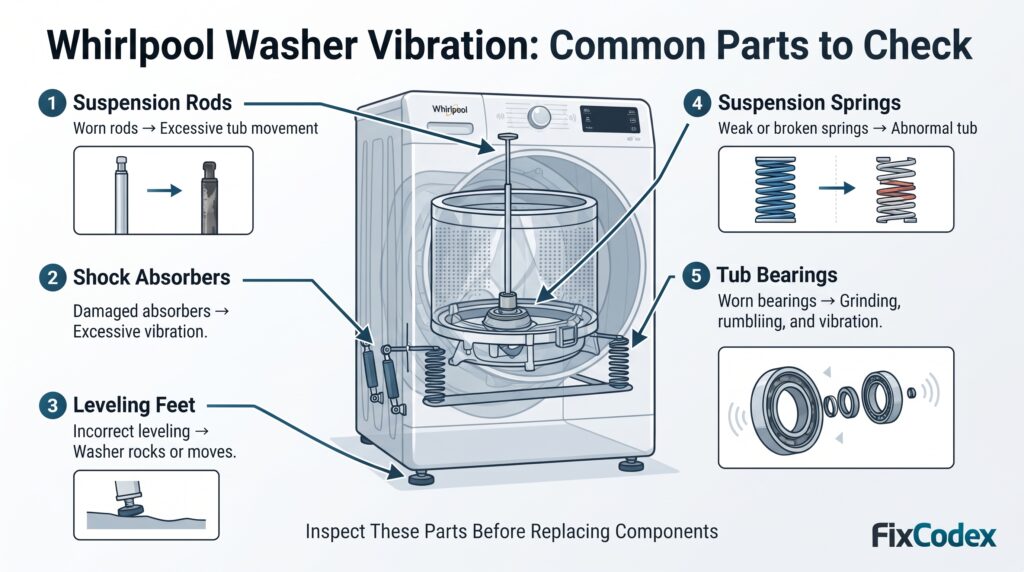
The following Whirlpool washer parts can contribute to excessive vibration:
Suspension Rods
Support and stabilize the wash basket on many top-load models. Worn rods can allow excessive tub movement.
Shock Absorbers
Help control tub movement on models equipped with them. Damaged absorbers can cause severe vibration during spin.
Leveling Feet
Keep the washer stable and level. Incorrect adjustment can cause the entire washer to rock or move.
Suspension Springs
Help support and stabilize the tub. A broken or stretched spring can cause abnormal movement.
Tub Bearings
Allow the basket to rotate smoothly. Worn bearings can cause rumbling, grinding, excessive movement, and vibration.
Whirlpool Washer Shaking or Bouncing? Try These Fixes!
Is your Whirlpool washer shaking, bouncing, or walking across the floor during spin? In this video, Bens Appliances and Junk shows practical fixes and useful tricks to help diagnose and stop excessive washer movement.
Watch the video to see what may be causing the problem and how to get your Whirlpool washer spinning smoothly again.
When Should You Replace a Whirlpool Washer Part?
Do not replace suspension or bearing parts simply because the washer vibrates.
Start with the easiest causes first:
Unbalanced load → leveling → floor stability → suspension components → bearings
If the washer vibrates only with certain loads, the load size or distribution is more likely to be the problem.
If it vibrates with almost every load, even when properly leveled and balanced, inspect the suspension system and other mechanical components.
Can You Keep Using a Whirlpool Washer That Vibrates?
A small amount of movement during spin can be normal. However, violent shaking, repeated banging, or a washer that moves significantly across the floor should not be ignored.
Continued excessive vibration can place additional stress on suspension components, hoses, wiring, bearings, and other washer components.
Stop using the washer if you notice severe vibration, unusual mechanical noises, water leaks, damaged components, or other signs of a potentially unsafe mechanical problem.
Whirlpool Washer Vibrating Excessively but No Error Code
A washer does not necessarily need to display an error code when it has a vibration problem.
Mechanical problems such as:
- Unbalanced loads
- Incorrect leveling
- Worn suspension rods
- Damaged shock absorbers
- Broken suspension springs
- Worn tub bearings
can cause excessive vibration without producing a diagnostic error code.
For this reason, inspect the washer’s physical condition even when the display shows no error.
Whirlpool Washer Error Codes Related to Excessive Vibration
Excessive vibration does not always generate an error code on a Whirlpool washer. However, some Whirlpool models may display an error when the control detects an out-of-balance load, a problem completing the spin cycle, or another condition that prevents normal operation.
Because error codes vary by model, always check the owner’s manual or technical sheet for the exact meaning of the code on your washer.
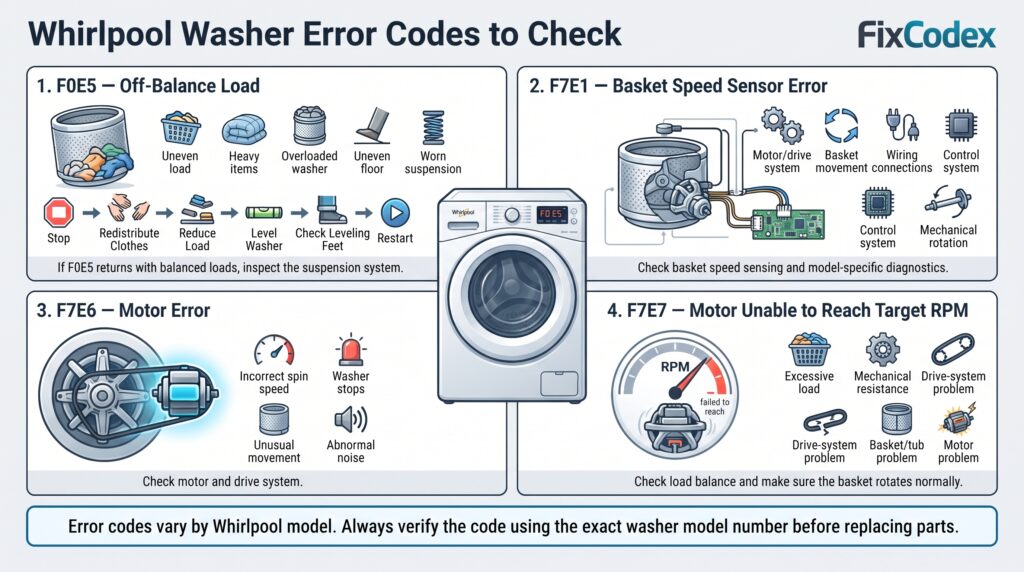
Whirlpool Washer Error Codes to Check
F0E5 — Off-Balance Load
The F0E5 error commonly indicates that the washer has detected an off-balance load.
Possible causes include:
- Clothes are gathered on one side of the basket
- Large or heavy items are unevenly distributed
- Washer is overloaded
- Washer is not level
- Suspension components are worn
How to Fix F0E5
- Stop the washer.
- Redistribute the clothes evenly.
- Remove some items if the washer is overloaded.
- Check that the washer is level.
- Make sure all leveling feet firmly contact the floor.
- Restart the washer and run the spin cycle.
If F0E5 repeatedly returns with normal, balanced loads, inspect the suspension system and other components that control tub movement.
F7E1 — Basket Speed Sensor Error
F7E1 can indicate a basket speed sensing problem on applicable Whirlpool washer models.
Although this is not specifically a vibration error, a problem detecting or controlling basket speed can affect the washer’s ability to complete the spin cycle normally.
Possible causes can include:
- Motor or drive-system problems
- Basket movement problems
- Wiring or connection issues
- Control-related problems
- Mechanical problems affecting basket rotation
The exact meaning and troubleshooting procedure can vary by model.
F7E6 — Motor Error
On applicable Whirlpool washers, F7E6 can indicate a motor-related problem.
A motor or drive problem may prevent the washer from reaching or maintaining the correct spin speed. This can sometimes be accompanied by unusual movement, stopping, or abnormal noises.
Check the model-specific technical information before replacing the motor or other drive components.
F7E7 — Motor Unable to Reach Target RPM
On models that use this code, F7E7 can indicate that the motor is unable to reach the expected speed.
Possible causes may include:
- Excessive load
- Mechanical resistance
- Drive-system problems
- Basket or tub problems
- Motor-related problems
If the washer is also vibrating excessively, first check whether the load is balanced and whether the basket can rotate normally.
Error Code Does Not Always Mean a Bad Part
An important point when diagnosing a vibrating Whirlpool washer is that an error code does not automatically mean a specific part has failed.
For example, an off-balance condition can be caused by something as simple as a large blanket becoming concentrated on one side of the basket.
Before replacing parts:
Check the load → Check leveling → Check the floor → Inspect suspension → Check mechanical components → Diagnose the error code
When to Check the Suspension System
If the washer repeatedly reports an off-balance condition even when the load is properly distributed, inspect the suspension components.
Depending on the Whirlpool model, check:
- Suspension rods
- Suspension springs
- Shock absorbers
- Tub support components
- Leveling feet
- Tub bearings
A worn suspension system can make it difficult for the washer to stabilize the basket during high-speed spin.
Important Note About Whirlpool Error Codes
Whirlpool washer error codes can vary between models and product series. The same code may have a different diagnostic meaning or troubleshooting procedure depending on the washer.
Always use the complete model number to identify the correct error-code definition, replacement parts, and service procedure.
If your Whirlpool washer displays an error code along with excessive vibration, use the code as a diagnostic clue rather than replacing a part immediately.
Find Whirlpool Washer Vibration Parts and Buy on eBay
If your Whirlpool washer is vibrating excessively and you need a replacement part, first identify the exact washer model number. Whirlpool uses different suspension rods, shock absorbers, springs, leveling feet, and tub components across different models.
Once you know the model number and the correct part number, you can search for the replacement part on eBay.
Common Whirlpool Washer Vibration Parts
Depending on your washer model, you may need one of these parts:
- Whirlpool washer suspension rods
- Whirlpool washer suspension rod kit
- Whirlpool washer shock absorbers
- Whirlpool washer suspension springs
- Whirlpool washer leveling feet
- Whirlpool washer tub bearings
- Whirlpool washer suspension components
How to Find the Correct Whirlpool Replacement Part
Before purchasing a replacement part, follow these steps:
- Find the complete Whirlpool washer model number.
- Search the model number in the washer’s parts diagram or service information.
- Identify the suspected defective component.
- Find the correct OEM or compatible replacement part number.
- Compare the part number with the seller’s listing.
- Check the listed compatible washer models.
- Review the seller’s return policy and item condition.
- Confirm that the part matches your washer before ordering.
Search by Part Number
Searching eBay by the exact part number is usually more reliable than searching only for “Whirlpool washer suspension.”
For example, instead of searching for:
Whirlpool washer vibration part
try searching for:
Whirlpool [exact part number]
This can help narrow the results to the specific replacement component you need.
Buy Whirlpool Washer Parts on eBay
You can search eBay for Whirlpool washer suspension rods, shock absorbers, leveling feet, suspension springs, bearings, and other replacement components.

Before You Buy
Always verify:
- Exact part number
- Whirlpool washer model number
- Compatible model list
- OEM or aftermarket status
- New or used condition
- Quantity included
- Seller feedback
- Return policy
Tip: If a suspension kit contains multiple rods or components, check the listing carefully to confirm exactly what is included before placing your order.
Finding the correct part number first can help prevent ordering a part that looks similar but does not fit your Whirlpool washer.
Frequently Asked Questions
Why is my Whirlpool washer shaking violently during spin?
The most common causes include an unbalanced load, an uneven washer, incorrect leveling, or worn suspension components. Check the load and leveling first before inspecting internal parts.
Why does my Whirlpool washer move across the floor?
A washer may move because it is not level, one or more leveling feet are not firmly contacting the floor, the load is severely unbalanced, or the suspension system is worn.
Why does my Whirlpool washer vibrate with every load?
If vibration occurs with nearly every load, check the washer’s leveling and suspension system. Worn suspension rods, springs, shock absorbers, or bearings may be contributing to the problem.
Can worn suspension rods cause excessive vibration?
Yes. On Whirlpool models that use suspension rods, worn rods can allow the tub to bounce and move excessively during the spin cycle.
Can bad bearings cause a Whirlpool washer to shake?
Worn tub bearings can contribute to vibration and often produce additional symptoms such as rumbling, grinding, or excessive basket movement.
Why does my washer only vibrate with heavy loads?
Heavy loads can become unbalanced more easily and place greater demands on the suspension system. Redistribute the load and avoid overloading the washer.
Do all Whirlpool washers use the same suspension parts?
No. Whirlpool uses different suspension systems and components across different washer models. Always identify the exact model number before ordering replacement parts.
If your Whirlpool washer is vibrating excessively, start with the simple causes before replacing expensive parts. Check the load, make sure the washer is level, inspect the leveling feet, and verify that the floor is stable.
If the problem continues, inspect the suspension rods, shock absorbers, suspension springs, and tub bearings used by your specific Whirlpool washer model.
Correcting excessive vibration early can help prevent additional wear and keep your washer operating more smoothly.
Important: Washer designs vary by model. Always use the correct Whirlpool model number and service information when diagnosing or replacing parts.
Other Washer Troubleshooting Guides:
- Whirlpool Washer Making Loud Noise
- Whirlpool Washer Not Completing the Cycle
- Whirlpool Washer Stuck on Sensing
Affiliate Disclosure: This page may contain affiliate links, including links to eBay. If you purchase a product through one of these links, we may earn a small commission at no additional cost to you. We only recommend products and parts that may be useful for repairing or maintaining your appliance.