
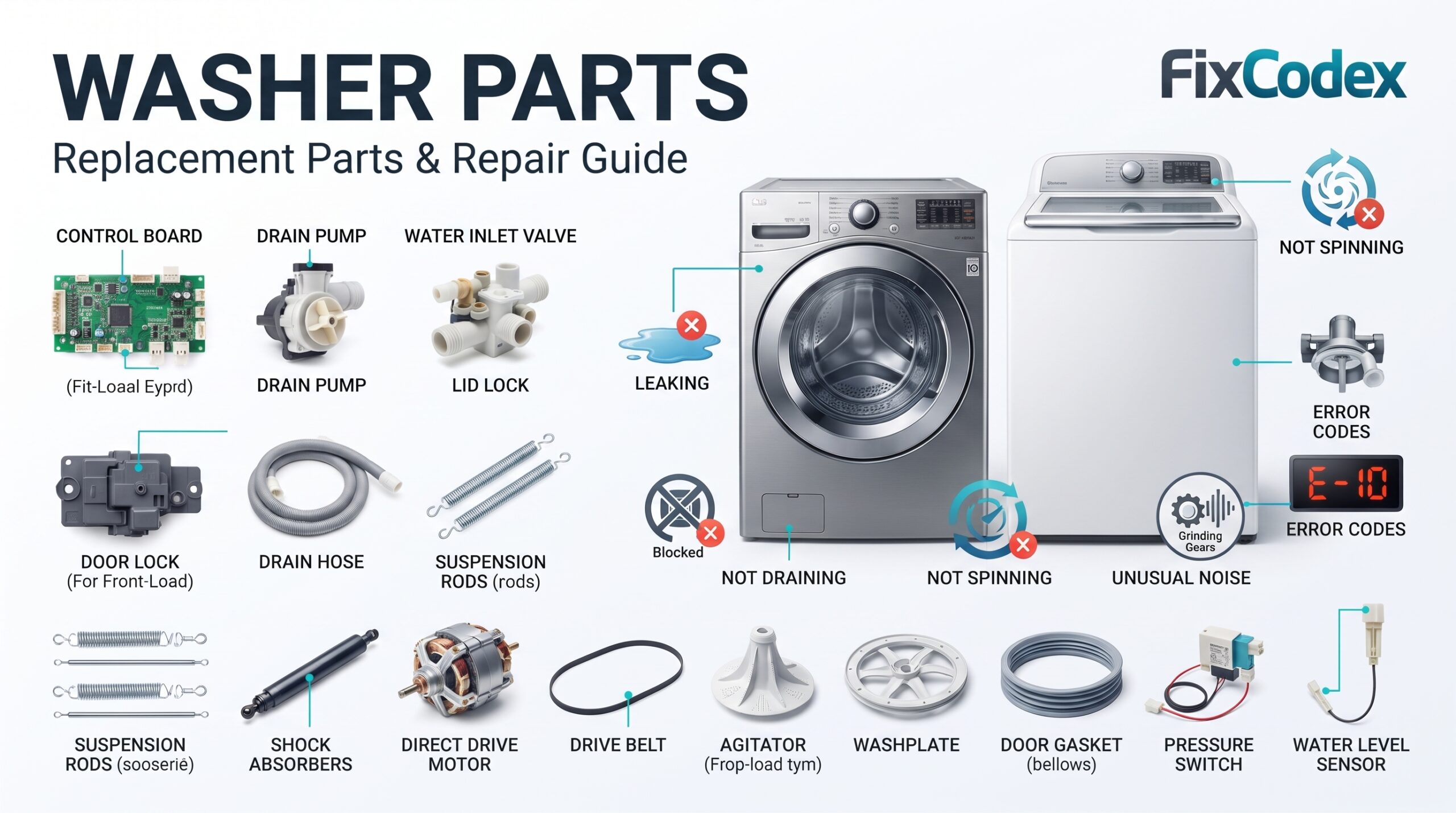
Finding the right washer replacement parts can make appliance repair easier and help extend the life of your washing machine.
Whether your washing machine won’t start, won’t drain, won’t spin, leaks, makes unusual noises, or displays an error code, the correct replacement part can often restore normal operation.
Common Washer Parts by Type
Below are the most common washing machine parts, with helpful information to identify the component you need and verify compatibility before ordering.
1. Washer Control Boards
Washer control boards manage many of the machine’s electrical functions and wash-cycle operations. A faulty control board can cause starting problems, error codes, cycle issues, or other unusual behavior.
- W11607637 Whirlpool Washer Control Board – Genuine OEM Part
- W11578563 Whirlpool Washer Control Board – Genuine OEM Replacement Part
- W11777413 Whirlpool Washer Control Board – Genuine OEM Electronic Control Replacement
- W11608056 Whirlpool Washer Control Board – Genuine OEM Replacement
- W11603811 Whirlpool Washer Control Board (Genuine OEM)
View more washer control boards here.
2. Washer Drain Pumps
Drain pumps remove used water from the washer during the drain cycle. A bad or clogged pump can cause standing water, slow draining, or a washer that stops before the spin cycle.
- W10276397 Whirlpool Washer Drain Pump
- W10876600 Whirlpool Washer Drain Pump
- W11458345 Whirlpool Washer Drain Pump
- DC31-00054A Samsung Washer Drain Pump
- 4681EA2001T LG Washer Drain Pump & Motor Assembly
View more washer drain pumps here.
3. Washer Water Inlet Valves
Water inlet valves control the flow of hot and cold water into the washer. A defective valve can cause slow filling, no water entering the washer, or incorrect water temperatures.
- W11513255 Whirlpool Washer Water Inlet Valve
- W11101906 Whirlpool Washer Water Inlet Valve
- W10144820 Whirlpool Washer Water Inlet Valve
- W11210463 Whirlpool Washer Water Inlet Valve
- Whirlpool Washer Water Inlet Valve 285805
View more washer water inlet valves here.
4. Washer Lid Locks
Lid locks secure the washer lid during operation, especially during high-speed spinning. A faulty lid lock can prevent the washer from starting or completing a cycle.
5. Washer Door Locks
Front-load washing machine use door locks to keep the door securely closed during operation. A defective door lock can prevent the washer from starting or cause door-related errors.
6. Washer Drain Hoses
Drain hoses carry wastewater from the washer to the household drain. A damaged, kinked, or clogged hose can cause slow drainage or water leaks.
7. Washer Suspension Rods
Suspension rods help support and stabilize the washer tub during operation. Worn suspension rods can cause excessive shaking, vibration, or an unbalanced washer.
8. Washer Shock Absorbers
Shock absorbers reduce tub movement during washing and spinning. Damaged shocks can cause loud banging, excessive vibration, and movement of the washer.
9. Washer Motors
The washer motor provides the power needed for important functions such as agitation and spinning. A failing motor may cause unusual noises, slow operation, or a washer that will not spin.
10. Washer Drive Motors
Drive motors transfer power to the washer’s basket or wash system. Problems with the drive motor can result in failure to agitate, spin, or complete the cycle.
11. Washer Belts
Belts transfer motor power to components that need mechanical movement. A worn, stretched, or broken belt can cause spinning or agitation problems.
12. Washer Agitators
Agitators move clothes through the water and detergent in many top-load washers. A damaged agitator can reduce washing performance or prevent proper movement of the load.
13. Washer Washplates
Washplates, also called impellers on some models, create movement inside high-efficiency top-load washers. A worn or damaged washplate can affect cleaning performance.
14. Washer Tub Bearings
Tub bearings allow the washer drum or basket to rotate smoothly. Worn bearings can produce loud rumbling, grinding, or other unusual noises during the spin cycle.
15. Washer Door Gaskets
Door gaskets create a seal between the front-load washing machine door and the tub. A damaged gasket can cause water leaks around the washer door.
16. Washer Door Seals
Door seals help prevent water from escaping during the wash cycle. Cracks, tears, or deterioration can result in leaks and water damage.
17. Washer Pressure Switches
Pressure switches help monitor the water level inside the washer. A faulty pressure switch can cause incorrect filling, overfilling, or drainage problems.
18. Washer Water Level Sensors
Water level sensors help the washer determine how much water is inside the tub. Sensor problems can cause incorrect water levels or cycle interruptions.
19. Washer Shift Actuators
Shift actuators control mechanical functions such as changing between agitation and spinning modes on compatible washers. A failed actuator can cause agitation or spin problems.
20. Washer Drain Filters
Drain filters trap lint, debris, coins, and other objects before they reach important components. A clogged filter can restrict water flow and cause drainage problems.
21. Washer Pump Filters
Pump filters help protect the drain pump from debris and foreign objects. Cleaning or replacing a restricted filter can sometimes restore proper drainage.
22. Washer Dispensers
Washer dispensers distribute detergent, bleach, and fabric softener at the appropriate time during the wash cycle. A clogged or damaged dispenser can cause dispensing problems.
23. Washer Timers
Timers control the sequence and duration of certain washer cycles on compatible models. A faulty timer can cause the washer to stop, advance incorrectly, or fail to complete a cycle.
24. Washer User Interface Boards
User interface boards contain the controls and display used to operate the washer. A defective UI board can cause button, display, or cycle-selection problems.
How to Choose the Right Washer Part
Before ordering any washer replacement part, verify the complete washer model number and part number. Similar-looking parts may not be interchangeable between different models or production revisions.
For the best results:
- Check the washer’s complete model number.
- Compare the existing part number.
- Check the manufacturer’s compatibility information.
- Compare connectors and physical design when appropriate.
- Confirm whether the part is OEM or aftermarket.
- Read the product specifications carefully before ordering.
Whether you need a washer control board, drain pump, water inlet valve, lid lock, motor, belt, suspension part, or another replacement component, identifying the correct part is the key to a successful repair.
Use the information above to narrow down the problem, find the appropriate replacement, and always verify model compatibility before ordering.
The right washing machine part can help restore performance, prevent unnecessary repairs, and extend the useful life of your washing machine.