
A Whirlpool washer making loud noises during operation is a common issue that many homeowners experience. Unusual sounds such as grinding, banging, squealing, or rattling can indicate a problem with internal components that may require inspection or repair.
Useful Tip: Check your washer pockets and load balance first—small objects and uneven loads can cause loud noises during operation.
The type of noise your Whirlpool washing machine makes can help identify the possible cause. In many cases, loud washer noises are caused by worn-out parts, loose components, foreign objects trapped inside the drum, or issues with the washer’s drive system.
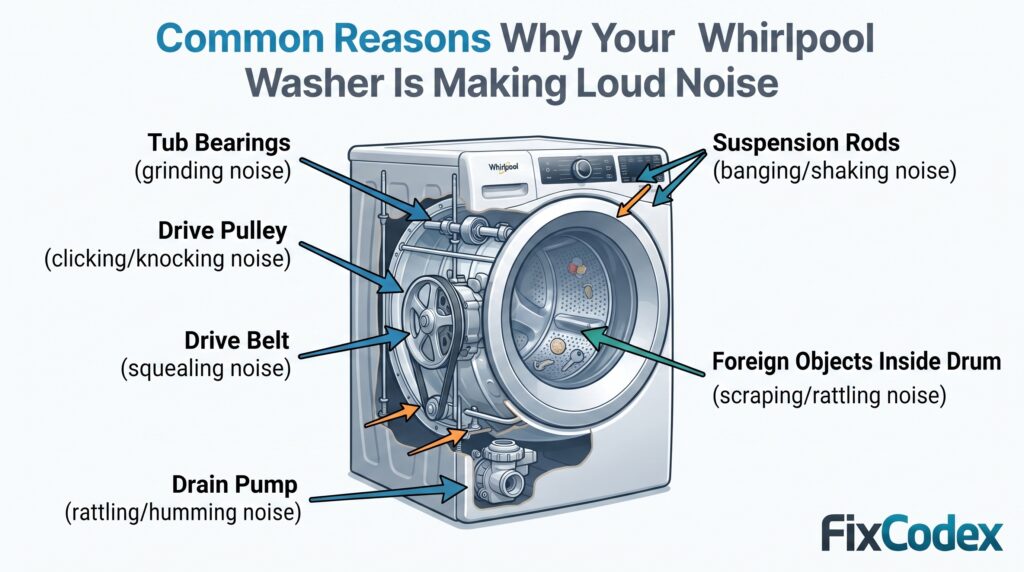
Common Reasons Why Your Whirlpool Washer Is Making Loud Noise
1. Worn Tub Bearings
The tub bearings allow the washer drum to rotate smoothly during wash and spin cycles. When these bearings become worn or damaged, they can create a loud grinding, rumbling, or roaring sound, especially during the spin cycle.
Signs of bad tub bearings include:
- Grinding or growling noise during spinning
- Washer drum movement or excessive shaking
- Noise that becomes louder at high spin speeds
- Water leaks near the tub area in severe cases
Replacing worn tub bearings can restore smooth and quiet washer operation.
2. Damaged Drive Pulley
The drive pulley helps transfer power from the motor to the washer drum. If the pulley becomes cracked, loose, or worn out, it may cause unusual noises while the washer is running.
Common symptoms of a damaged drive pulley:
- Loud clicking or knocking sounds
- Irregular drum movement
- Noise during wash or spin cycles
- Washer not spinning properly
Inspect the pulley for cracks, looseness, or signs of wear.
3. Loose or Damaged Components
Loose parts inside or around the washer can create banging, rattling, or knocking sounds. Screws, panels, suspension components, or internal hardware may become loose over time due to normal vibration.
Check for:
- Loose bolts or screws
- Damaged suspension parts
- Loose motor or drive components
- Items trapped between the drum and tub
4. Objects Trapped Inside the Drum
Small items such as coins, buttons, screws, or clothing accessories can get stuck between the inner drum and outer tub. These objects often create rattling or scraping sounds during operation.
Common signs include:
- Rattling noise while spinning
- Scraping sounds during drum rotation
- Noise that comes and goes depending on the drum position
Always check pockets before washing clothes to prevent foreign objects from entering the washer.
Whirlpool Washer Error Codes Related to Loud Noise Problems
If your Whirlpool washer is making loud noises and displaying an error code, the code can provide clues about the cause of the problem.
While many noise issues are caused by mechanical parts such as bearings, belts, pulleys, or pumps, certain Whirlpool washer error codes may indicate problems with draining, spinning, motor operation, or load balance.
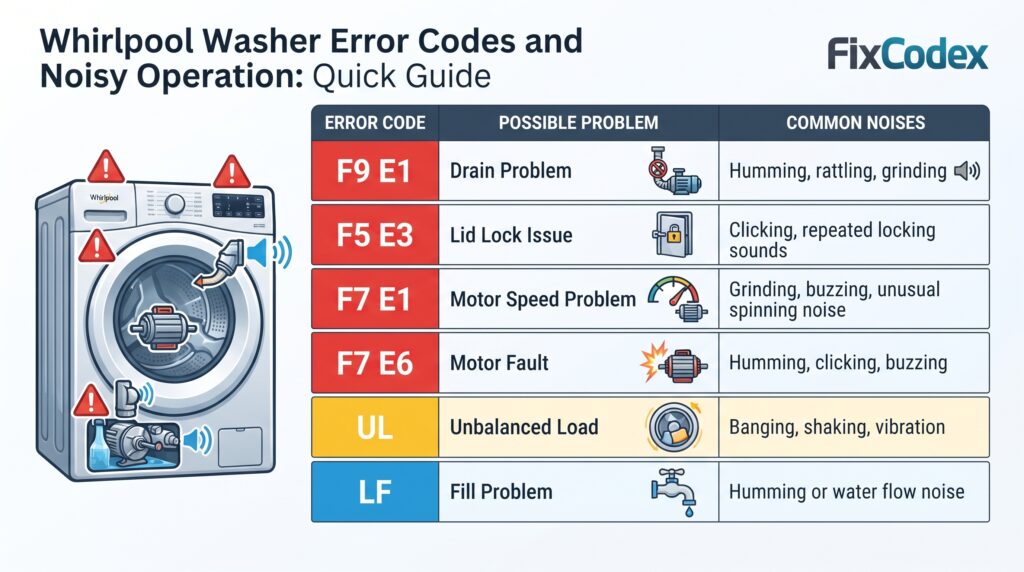
Below are common Whirlpool washer error codes that may be related to unusual noises.
Whirlpool Washer F9 E1 Error Code – Long Drain Issue
The F9 E1 error code indicates that the washer is taking too long to drain. A blocked drain pump, clogged hose, or damaged pump can create humming, rattling, or grinding noises during the drain cycle.
Possible causes:
- Clogged drain pump filter
- Foreign objects inside the drain pump
- Blocked drain hose
- Faulty drain pump motor
Parts to check:
- Drain pump
- Drain hose
- Pump filter
Whirlpool Washer F5 E3 Error Code – Lid Lock Problem
The F5 E3 error code indicates a lid unlock issue on many Whirlpool top-load washers. A faulty lid lock assembly may cause clicking or repeated locking sounds.
Possible causes:
- Damaged lid lock assembly
- Misaligned lid
- Control board issue
Parts to check:
- Lid lock assembly
- Lid strike
- Wiring connections
Whirlpool Washer F7 E1 Error Code – Motor Speed Sensing Problem
The F7 E1 error code indicates a problem detecting the correct motor speed. The washer may make unusual noises if the motor, drive system, or basket movement is affected.
Possible causes:
- Drive system problem
- Motor issue
- Faulty speed sensor
- Mechanical obstruction
Parts to check:
- Drive motor
- Rotor or stator (model dependent)
- Motor sensor
- Wiring connections
Whirlpool Washer F7 E6 Error Code – Motor Fault
The F7 E6 error code indicates a motor circuit problem. A failing motor may produce humming, buzzing, clicking, or abnormal operating sounds.
Possible causes:
- Defective drive motor
- Damaged motor wiring
- Control board failure
- Mechanical resistance in the drum
Parts to check:
- Drive motor
- Motor harness
- Control board
Whirlpool Washer UL Error Code – Unbalanced Load
The UL error code indicates that the washer detected an unbalanced load. This can cause loud banging, shaking, and vibration during the spin cycle.
Possible causes:
- Too many clothes in one area
- Overloaded washer
- Uneven distribution of laundry
- Worn suspension components
Parts to check:
- Suspension rods
- Shock absorbers
- Washer leveling feet
Whirlpool Washer LF Error Code – Water Fill Problem
The LF (Long Fill) error code means the washer is taking too long to fill with water. Although this code is not directly related to noise, restricted water flow or valve problems may cause unusual sounds.
Possible causes:
- Low water pressure
- Clogged inlet screens
- Faulty water inlet valve
Parts to check:
- Water inlet valve
- Inlet hoses
- Water supply connections
Whirlpool Washer Error Codes and Noisy Operation: Quick Guide
| Error Code | Possible Problem | Common Noise |
|---|---|---|
| F9 E1 | Drain problem | Humming, rattling, grinding |
| F5 E3 | Lid lock issue | Clicking, repeated locking sounds |
| F7 E1 | Motor speed problem | Grinding, buzzing, unusual spinning noise |
| F7 E6 | Motor fault | Humming, clicking, buzzing |
| UL | Unbalanced load | Banging, shaking, vibration |
| LF | Fill problem | Humming or water flow noise |
What to Do When Your Whirlpool Washer Shows an Error Code and Makes Noise
- Turn off the washer and unplug it for a few minutes.
- Check for overloaded or unbalanced loads.
- Inspect the drum for trapped objects.
- Check drain hoses and filters for blockages.
- Identify when the noise occurs:
- During filling
- During washing
- During draining
- During the spin cycle
- If the error returns, inspect the related component or contact a qualified appliance repair technician.
Understanding the error code along with the type of noise can help diagnose the problem faster and prevent additional damage to your Whirlpool washer.
Common Whirlpool Washer Noise Problems and Their Causes
Whirlpool Washer Making a Grinding Noise
A grinding sound usually points to a problem with:
- Tub bearings
- Drive components
- Motor-related parts
If the noise is loudest during the spin cycle, worn bearings are a common cause.
Whirlpool Washer Making a Banging or Knocking Noise
Banging noises may be caused by:
- Unbalanced loads
- Worn suspension rods
- Loose internal components
- Damaged drum supports
Try redistributing the clothes and running another cycle. If the noise continues, inspect the suspension system.
Whirlpool Washer Making a Squealing or Screeching Noise
High-pitched squealing may indicate:
- Worn drive belt
- Faulty pulley
- Motor issues
- Belt slipping during operation
A damaged belt should be replaced to prevent further washer problems.
Whirlpool Washer Making a Rattling Noise
Rattling sounds often come from:
- Foreign objects inside the drum
- Loose hardware
- Drain pump problems
Inspect the drum and check the drain pump filter if your model includes one.
Common Parts to Check on a Noisy Whirlpool Washer
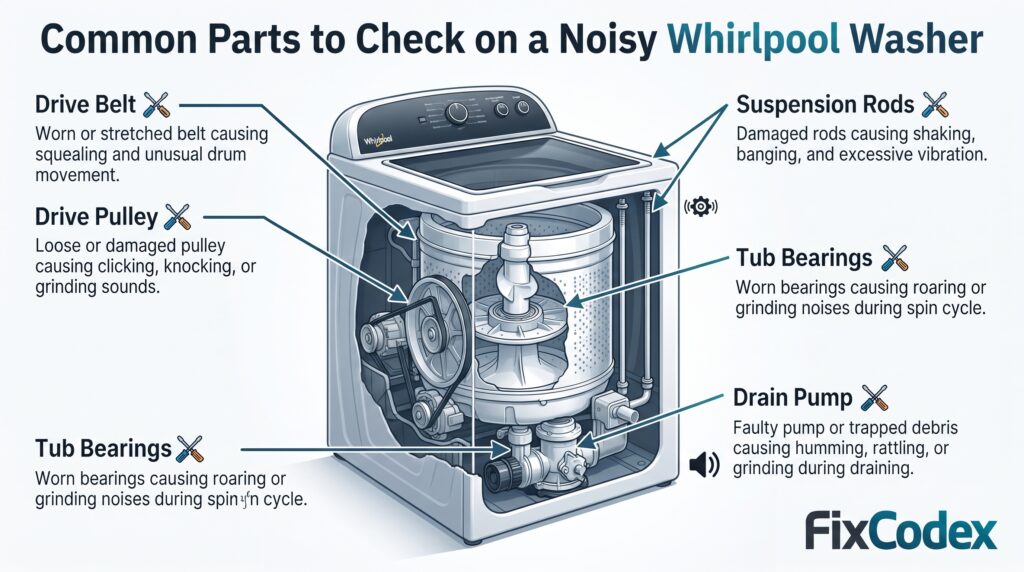
When troubleshooting a Whirlpool washer making loud noise, inspect these common components:
Drive Belt
The drive belt connects the motor to the washer drum. A worn, stretched, or damaged belt can cause squealing or unusual movement.
Drive Pulley
A damaged or loose drive pulley may create clicking, knocking, or grinding sounds during operation.
Tub Bearings
Worn tub bearings are one of the most common causes of loud roaring or grinding noises during the spin cycle.
Suspension Rods
Suspension rods help stabilize the washer tub. Damaged rods can cause excessive shaking, banging, and vibration.
Drain Pump
A faulty drain pump or trapped debris can cause humming, rattling, or grinding noises, especially during draining.
How to Troubleshoot a Whirlpool Washer Making Loud Noise
Follow these steps to help locate the source of the noise:
- Stop the washer and unplug it
- Always disconnect power before inspecting internal parts.
- Check for foreign objects
- Look inside the drum for coins, buttons, or other items.
- Run a small test load
- An overloaded or unbalanced load can create excessive noise.
- Inspect visible components
- Check the belt, pulley area, and suspension system for damage.
- Listen during different cycles
- Identify whether the noise occurs during washing, draining, or spinning.
Watch This Whirlpool Washer Noise Repair Video Before Replacing Parts
Is your Whirlpool washer making a loud noise during the spin cycle? This helpful diagnostic video from ApplianceVideo.com shows how to identify the cause of basket-related noises and troubleshoot common washer problems before starting a repair.
When to Call a Professional Appliance Repair Technician
Some washer noises can be fixed with simple adjustments, but certain problems require professional repair. Contact an appliance technician if your Whirlpool washer has:
- Loud grinding during every spin cycle
- A drum that moves excessively
- Water leaking from the washer
- A washer that stops spinning
- Persistent loud noises after basic troubleshooting
Repairing major components such as tub bearings, motors, or internal drive parts may require specialized tools and experience.
Buy Whirlpool Washer Replacement Parts on eBay
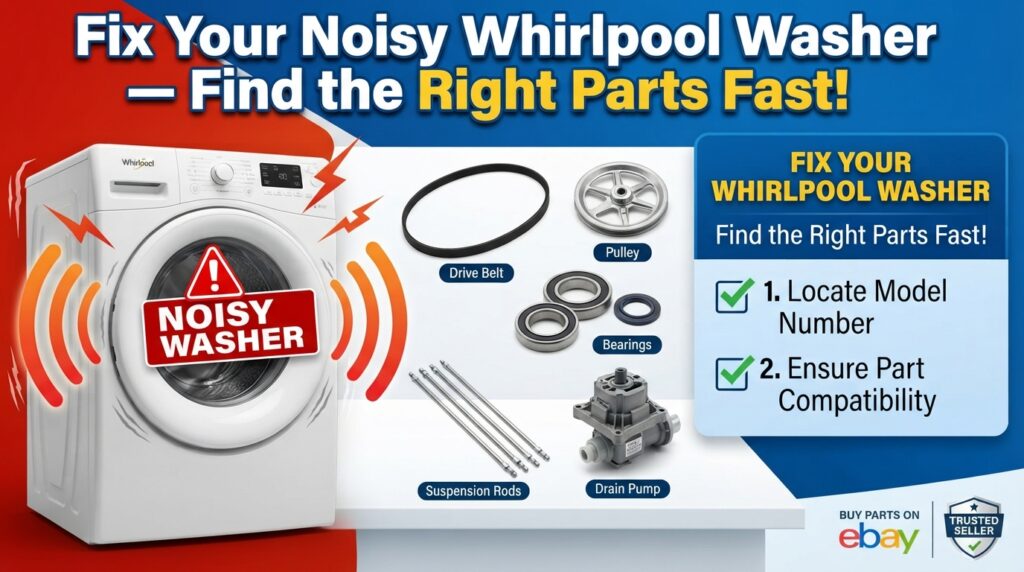
If your Whirlpool washer is making loud noises, replacing worn or damaged parts may fix the problem. Common replacement parts such as drive belts, pulleys, drain pumps, suspension rods, and bearings are available on eBay.
Before buying, check your Whirlpool washer model number and match the part number to ensure compatibility.
Common Parts to Buy:
- Drive Belt – Fixes squealing, slipping, or spinning issues
- Drive Pulley – Helps resolve clicking, knocking, or grinding noises
- Tub Bearings – Repairs loud grinding or rumbling during spin cycles
- Suspension Rods – Reduces shaking and banging noises
- Drain Pump – Fixes humming, rattling, or draining problems
Find compatible Whirlpool washer replacement parts on eBay:
Always verify the part compatibility with your washer model before purchasing.
Frequently Asked Questions
Why is my Whirlpool washer making a loud grinding noise?
A loud grinding noise is often caused by worn tub bearings, a damaged drive pulley, or a problem with the washer’s drive system. The noise is usually most noticeable during the spin cycle.
Why does my Whirlpool washer make a banging sound during spinning?
Banging sounds can happen when the load is unbalanced, suspension rods are worn, or internal components are loose or damaged.
Can I still use my Whirlpool washer if it is making loud noises?
It depends on the cause. Minor issues like an unbalanced load may be safe to correct, but continued use with damaged bearings or drive components can lead to more expensive repairs.
How much does it cost to repair a noisy Whirlpool washer?
The repair cost depends on the failed component. Simple fixes such as removing trapped objects may be inexpensive, while replacing bearings or major drive parts can cost significantly more.
A Whirlpool washer making loud noise should not be ignored. Identifying whether the sound is grinding, banging, squealing, or rattling can help determine the source of the problem.
Checking common parts like the drive belt, drive pulley, tub bearings, suspension rods, and drain pump can help diagnose the issue and prevent further damage.
Regular maintenance, avoiding overloaded loads, and checking clothing pockets before washing can help keep your Whirlpool washer running smoothly and quietly.
Other Washer Troubleshooting Guides:
Washer Main Control Boards:
- W11578571 Whirlpool Washer Control Board
- W11629601 Whirlpool Washer Control Board
- W11777413 Whirlpool Washer Control Board
Affiliate Disclosure: This page may contain affiliate links. If you purchase a product through one of these links, we may earn a small commission at no additional cost to you. We only recommend products and parts that may help with your appliance repair needs.
1 thought on “Whirlpool Washer Making Loud Noise: Causes, Symptoms, and How to Fix It”