
If your Whirlpool WTW5000DW washer is not agitating, your clothes may sit in the water without moving properly during the wash cycle. You may also notice that the washer fills and drains normally but does not move the wash plate, or that it makes a clicking, humming, or grinding noise during agitation.
The good news is that a Whirlpool WTW5000DW that is not agitating does not necessarily need a major repair. The problem can be caused by something simple, such as an incorrect cycle or an overloaded washer, but mechanical or electrical components can also prevent the wash plate from moving.
This guide explains the most common causes of a Whirlpool WTW5000DW not agitating, what to check first, and which parts may need to be inspected or replaced.
Important: Always unplug the washer from the electrical outlet before inspecting or replacing internal components.
Quick Answer: Why Is My Whirlpool WTW5000DW Not Agitating?
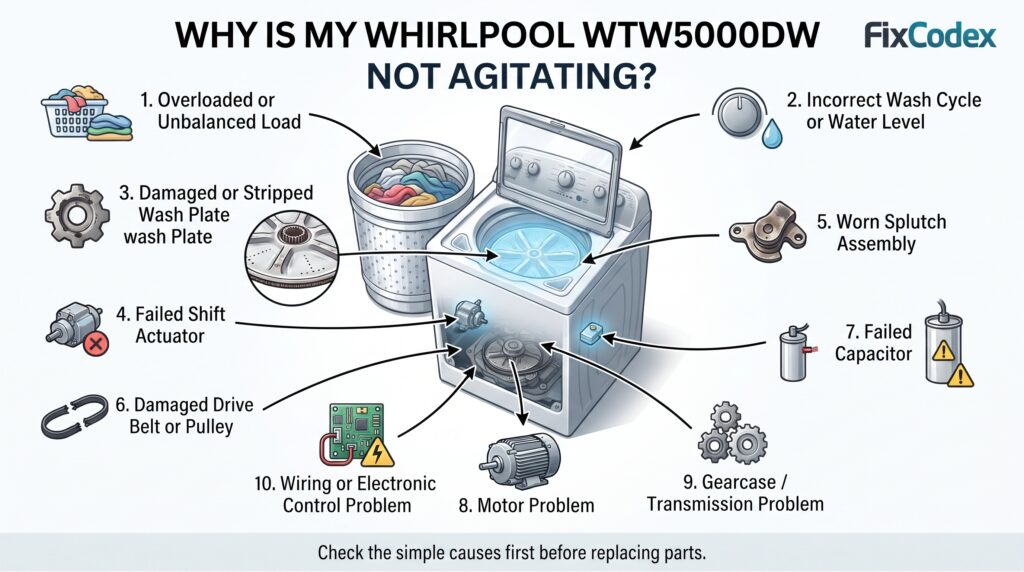
The most common causes include:
- Overloaded or unbalanced wash load
- Incorrect wash cycle or water level
- Damaged or stripped wash plate
- Failed shift actuator
- Worn splutch assembly
- Damaged drive belt or pulley components
- Failed capacitor
- Motor problem
- Transmission or gearcase problem
- Wiring or electronic control problem
Whirlpool recommends checking the load and selected cycle first because an unbalanced load or an unsuitable low-water cycle can result in poor agitation performance.
For a mechanical failure, the exact cause should be diagnosed before buying replacement parts.
Symptoms of a Whirlpool WTW5000DW That Won’t Agitate
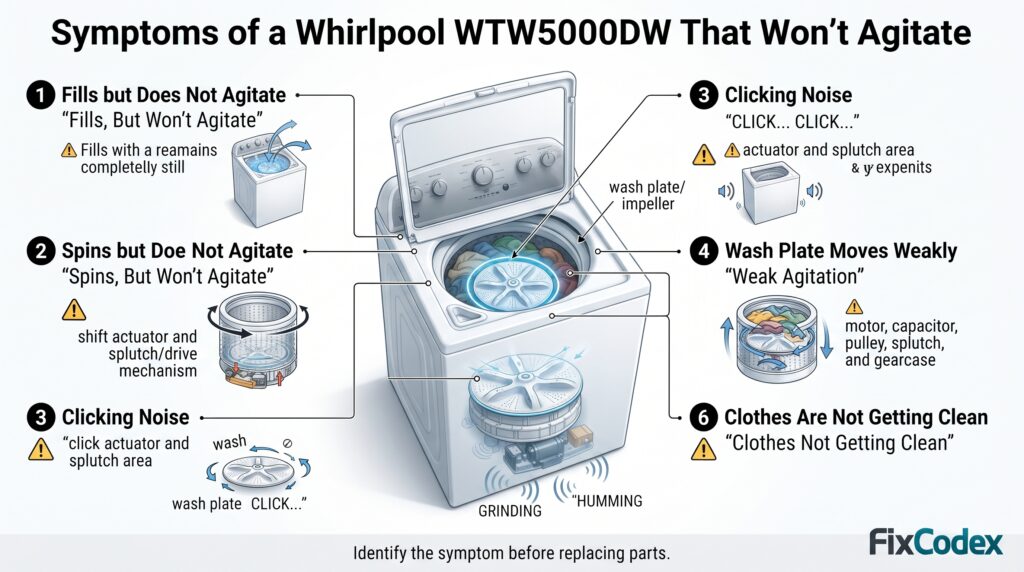
Your washer may have an agitation problem if you notice one or more of these symptoms:
1. Washer Fills but Does Not Agitate
The washer fills with water normally, but after filling, the wash plate does not move.
This can indicate a problem with the drive system, actuator, splutch, wash plate, motor, capacitor, or control system.
2. Washer Spins but Does Not Agitate
This is an especially useful symptom.
If the washer can spin but cannot agitate, the motor may still be capable of operating, so the problem may be related to the mechanism that switches the drive system between agitation and spin.
A faulty actuator or worn splutch can prevent the washer from properly entering the agitation mode.
3. Washer Makes a Clicking Noise
A repeated clicking sound during the wash cycle can indicate that the actuator or splutch mechanism is not engaging correctly.
However, noise alone is not enough to identify the failed component. The drive system should be inspected before replacing parts.
4. Wash Plate Moves Very Weakly
If the wash plate moves but has very little power, possible causes include a worn wash plate, damaged drive components, a weak motor system, or a failing capacitor.
5. Washer Makes a Grinding or Humming Noise
Grinding, buzzing, or humming without normal agitation can indicate a mechanical obstruction or a problem with the motor, capacitor, splutch, pulley, or gearcase.
6. Clothes Are Not Getting Clean
When the wash plate does not move correctly, clothes may remain mostly stationary in the tub. This reduces the mechanical action needed to move water and detergent through the clothing.
1. Check the Load Before Replacing Parts
Before taking the washer apart, check the load.
An overloaded or badly unbalanced load can interfere with normal washer operation. Whirlpool notes that an uneven load can cause reduced performance and other cycle problems.
Try this:
- Stop the washer.
- Remove some clothing if the basket is tightly packed.
- Redistribute the clothing evenly.
- Select an appropriate wash cycle.
- Restart the washer.
- Watch the wash plate during the agitation portion of the cycle.
Avoid packing the basket tightly. The washer needs room for the clothing and water to move properly.
2. Check the Selected Wash Cycle
Some Whirlpool cycles use lower water levels as part of their normal operation.
Whirlpool explains that selecting a low-water cycle instead of a cycle designed for higher water levels can make clothing more difficult to agitate properly.
Try a normal cycle appropriate for the size and type of load.
If the washer agitates normally afterward, there may not be a mechanical problem.
3. Inspect the Wash Plate
The wash plate, sometimes called an impeller, is the rotating component at the bottom of the washer basket that creates the washing action.
If the wash plate is damaged or its splines are worn or stripped, the motor may operate without transferring movement properly to the wash plate.
Possible symptoms of a damaged wash plate include:
- Wash plate barely moves
- Wash plate turns freely when it should not
- Washer spins but does not agitate
- Clothes are not moving through the water
- Grinding or slipping sounds
- Visible damage or wear around the wash plate
For some WTW5000DW variants, repair technicians and DIY users have reported stripped wash-plate or drive splines as a possible cause of poor or missing agitation.
If the wash plate is damaged, replace it with a part specifically matched to your washer’s complete model number.
4. Check the Shift Actuator
The shift actuator is an important component in the washer’s drive system.
Its job is to help move the drive mechanism into the correct position for different operating modes, including agitation and spin.
If the actuator fails or does not move correctly, the washer may have problems changing between these modes.
A bad actuator may cause:
- Washer spins but does not agitate
- Washer agitates incorrectly
- Clicking noises
- Washer gets stuck in one operating mode
- Error codes
- Drive mechanism does not shift correctly
A recent repair discussion involving a WTW5000DW3 reported that replacing the shift actuator restored agitation after the washer was filling excessively and failing to agitate correctly. This is an example of a reported repair, not proof that the actuator is the cause on every WTW5000DW washer.
The actuator should be tested before purchasing a replacement.
5. Inspect the Splutch Assembly
The splutch assembly is another important part of the Whirlpool washer drive system.
It helps transfer and control power between the motor and the washer’s different operating modes.
A worn or damaged splutch can prevent proper agitation.
Symptoms may include:
- Washer spins but does not agitate
- Clicking during the wash cycle
- Grinding or slipping sounds
- Wash plate does not move correctly
- Drive system appears to operate but agitation is missing
A repair reference for the WTW5000DW0 identifies the splutch pulley and cam assembly as one possible cause of a no-agitation problem. The listed Whirlpool part for that specific model was W10721967.
Do not assume W10721967 fits every WTW5000DW washer. Whirlpool model numbers have different revisions, so verify the complete model number and part compatibility before ordering.
6. Check the Drive Belt and Pulley
The washer’s motor needs to transfer mechanical power through the drive system.
If the belt is damaged, loose, broken, or slipping, the washer may not agitate correctly.
Inspect for:
- Broken belt
- Excessive belt wear
- Loose belt
- Damaged pulley
- Obstructions
- Excessive belt dust
- Unusual noises underneath the washer
If the belt looks damaged, replace it with the correct part for your exact washer model.
7. Test the Washer Capacitor
A failed capacitor can cause motor-related problems.
The motor may hum, struggle to start, or fail to produce enough torque for normal operation.
Possible symptoms include:
- Humming noise
- Motor struggles to start
- Washer does not agitate
- Washer does not spin
- Washer stops under load
- Motor overheats
A repair example involving a Whirlpool top-load washer with a similar drive design found an incorrectly reading capacitor to be the cause of a washer that would not agitate or spin.
Because washer configurations vary, test the capacitor according to the service information for your specific model.
8. Check the Drive Motor
If the mechanical components appear to be working correctly, the drive motor may need to be tested.
A motor problem can cause the washer to:
- Fill normally but not agitate
- Hum without turning
- Stop during the cycle
- Fail to spin
- Make unusual noises
- Operate intermittently
Before replacing the motor, check the belt, pulley, splutch, actuator, capacitor, wiring, and other related components.
Replacing a motor without diagnosing the actual problem can be an unnecessary expense.
9. Inspect the Gearcase or Transmission
The gearcase is a more serious possibility.
If the washer has already been checked for simpler problems and the drive components appear to be working, the gearcase may need further diagnosis.
Possible symptoms can include:
- Grinding noises
- Poor or missing agitation
- Mechanical slipping
- Excessive noise
- Wash plate movement problems
- Visible oil or mechanical damage
A professional diagnosis may be worthwhile if the problem appears to involve the gearcase because this repair can be significantly more involved than replacing an actuator or wash plate.
10. Check the Wiring and Connections
A loose, damaged, or corroded electrical connection can prevent a component from operating.
Inspect the wiring harnesses and connectors for:
- Loose connectors
- Broken wires
- Damaged insulation
- Corrosion
- Burn marks
- Rodent damage
- Connectors that are not fully seated
Always disconnect electrical power before inspecting wiring.
Whirlpool WTW5000DW2 Not Agitating? Watch This Repair Video
Is your Whirlpool WTW5000DW2 washer not agitating even though it fills with water and appears to run normally? If the clothes aren’t getting clean and the wash plate isn’t moving properly, there could be a problem with the wash plate, drive system, or another internal component.
Before replacing parts, take a look at this helpful repair video by Derrickwith2rs. The video focuses specifically on the Whirlpool WTW5000DW2 washer not agitating and demonstrates how to investigate the problem. It also discusses a situation where the wash plate is no longer agitating freely from the basket.
🎥 Watch the Video
Whirlpool model WTW5000DW2 washer not agitating — Derrickwith2rs
If your WTW5000DW2 won’t agitate, this video can be a useful reference before you start taking the washer apart or ordering replacement parts.
Tip: Make sure you identify the complete washer model number before purchasing a replacement part. Whirlpool WTW5000DW-series washers can have different components depending on the model revision.
Whirlpool WTW5000DW Not Agitating but Still Spinning
One of the most useful clues is:
“My Whirlpool WTW5000DW spins but does not agitate.”
If the washer can spin normally but cannot agitate, pay particular attention to the components involved in changing between the two operating modes.
Potential areas to investigate include:
- Shift actuator
- Splutch assembly
- Wash plate
- Drive components
- Gearcase
- Wiring and control signals
There are documented WTW5000DW owner repair cases where replacing the splutch restored agitation after an actuator replacement did not solve the problem.
This is why replacing parts based only on the symptom can be expensive. Test the system and inspect the mechanical components first.
Whirlpool WTW5000DW Makes Noise but Does Not Agitate
If your washer makes noise but the wash plate does not move, listen carefully to the type of noise.
Clicking
Possible areas:
- Actuator
- Splutch
- Drive mechanism
Humming
Possible areas:
- Capacitor
- Motor
- Mechanical obstruction
Grinding
Possible areas:
- Splutch
- Pulley
- Wash plate
- Gearcase
- Other mechanical components
Loud banging
Check the load and suspension system first. An unbalanced load can cause excessive movement and poor washer performance. Whirlpool recommends redistributing an unbalanced load and selecting the appropriate cycle.
Whirlpool WTW5000DW Agitator vs. Wash Plate
An important terminology issue can make troubleshooting confusing.
The WTW5000DW family uses a wash plate/impeller-style washing system, rather than the tall traditional agitator found in some older top-load washers.
Therefore, when searching for parts, you may see terms such as:
- Wash plate
- Impeller
- Agitator
- Agitator assembly
- Drive assembly
These terms are sometimes used differently by appliance-parts sellers.
When ordering a replacement part, don’t rely only on the phrase “Whirlpool WTW5000DW agitator.”
Instead, verify:
Complete model number + part number + manufacturer compatibility
Whirlpool WTW5000DW Not Agitating: Troubleshooting Checklist
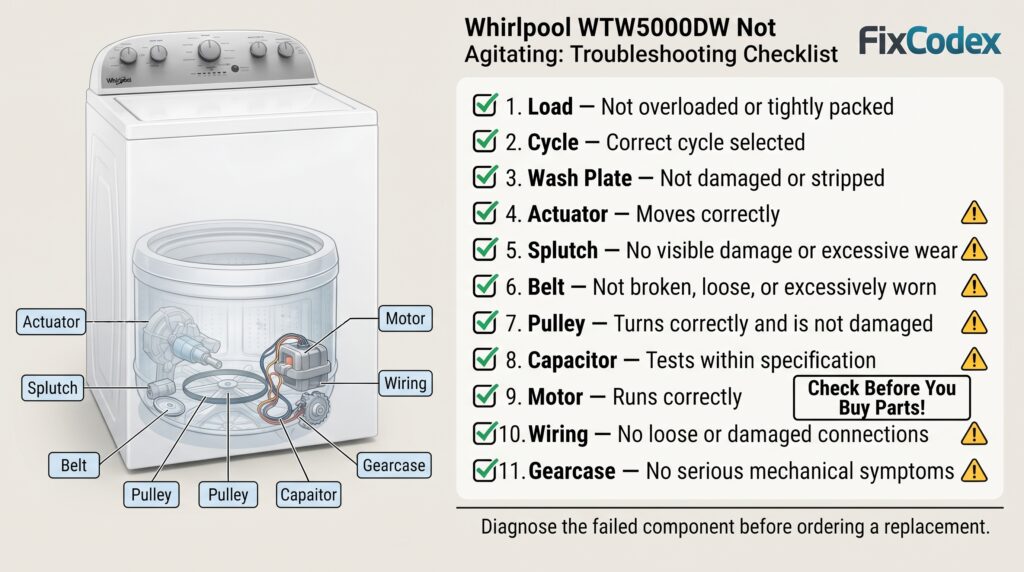
Use this checklist before ordering a replacement part.
| Check | What to Look For |
|---|---|
| Load | Not overloaded or tightly packed |
| Cycle | Correct cycle selected |
| Wash plate | Not damaged or stripped |
| Actuator | Moves correctly |
| Splutch | No visible damage or excessive wear |
| Belt | Not broken, loose, or excessively worn |
| Pulley | Turns correctly and is not damaged |
| Capacitor | Tests within specification |
| Motor | Runs correctly |
| Wiring | No loose or damaged connections |
| Gearcase | No serious mechanical symptoms |
How to Diagnose a Whirlpool WTW5000DW That Won’t Agitate
A logical diagnostic sequence can save you money.
Step 1: Confirm the symptom
Does the washer:
- Fill?
- Drain?
- Spin?
- Agitate?
Knowing which functions work can narrow down the problem.
Step 2: Check the load
Remove excess clothing and redistribute the load.
Step 3: Check the cycle
Try an appropriate normal wash cycle.
Step 4: Observe the wash plate
Does it move during agitation?
Step 5: Listen
Identify whether you hear:
- Clicking
- Humming
- Grinding
- Buzzing
- No sound at all
Step 6: Inspect the drive system
Check the actuator, splutch, pulley, belt, and wash plate.
Step 7: Test electrical components
If necessary, test the capacitor, motor, wiring, and control system using the appropriate service procedures.
Step 8: Replace only the failed component
Don’t replace multiple parts simply because they are commonly associated with the symptom.
When Should You Replace a Whirlpool WTW5000DW Part?
A replacement part makes sense when the original component has been properly diagnosed as defective.
Common parts that may be involved in a no-agitation repair include:
- Whirlpool wash plate
- Shift actuator
- Splutch assembly
- Drive belt
- Drive pulley
- Capacitor
- Drive motor
- Gearcase
- Electronic control board
The exact part number depends on the complete model number, such as WTW5000DW0, WTW5000DW1, WTW5000DW2, WTW5000DW3, or another revision.
Do not order a part using only WTW5000DW.
How to Find the Correct Whirlpool WTW5000DW Replacement Part
Before purchasing a replacement part, locate the complete model number from the washer’s model/serial label.
For example:
WTW5000DW0
is different from:
WTW5000DW1
or:
WTW5000DW2
Even when the washers look very similar, components can vary between model revisions.
When searching for a replacement part, use:
“Whirlpool WTW5000DW [complete model number] [part name]”
For example:
Whirlpool WTW5000DW0 wash plate
or:
Whirlpool WTW5000DW1 shift actuator
This helps reduce the risk of ordering an incompatible part.
Where to Buy Whirlpool WTW5000DW Parts
If your diagnosis confirms that a component needs to be replaced, you can compare compatible Whirlpool washer parts through online appliance-parts retailers and marketplaces such as eBay.
Before ordering, verify:
- Complete washer model number
- Part number
- Part description
- Compatibility information
- Seller information
- Return policy
For affiliate links, you can add your preferred product links here.

Frequently Asked Questions
Why is my Whirlpool WTW5000DW not agitating?
Possible causes include an overloaded load, incorrect cycle, damaged wash plate, failed actuator, worn splutch, belt or pulley problem, capacitor failure, motor problem, wiring issue, or gearcase problem.
Start with the simple checks before replacing parts.
Why does my Whirlpool WTW5000DW spin but not agitate?
When the washer spins but does not agitate, inspect the shift actuator, splutch, wash plate, and related drive components. A problem in the mechanism that switches between agitation and spin can produce this symptom.
Why does my Whirlpool WTW5000DW make a clicking noise?
A clicking noise during agitation may come from the actuator or splutch mechanism, although other mechanical problems can also produce clicking sounds.
Inspect the drive system before replacing a part.
Can a bad wash plate cause a Whirlpool WTW5000DW not to agitate?
Yes. A worn or stripped wash plate or its drive connection can prevent the motor’s movement from being transferred properly to the wash plate.
Can a bad capacitor cause a Whirlpool washer not to agitate?
Yes. A failed capacitor can prevent the motor from starting or operating with sufficient torque. The capacitor should be tested before replacement.
Should I replace the control board?
Not necessarily.
A control board can cause washer functions to fail, but several mechanical components can produce the same no-agitation symptom. Diagnose the washer before purchasing an expensive control board.
Why does my washer fill but not agitate?
If the washer fills normally but does not begin agitation, the problem may be in the drive system, motor system, actuator, splutch, wash plate, capacitor, wiring, or control system.
Is Whirlpool WTW5000DW not agitating an expensive repair?
It depends on the failed component. A simple actuator, belt, or wash plate repair may be considerably less involved than a motor or gearcase repair.
Diagnosing the problem first can help avoid unnecessary parts costs.
A Whirlpool WTW5000DW not agitating can be caused by something as simple as an overloaded load or incorrect cycle, but mechanical and electrical problems are also possible.
The best approach is to troubleshoot from simple to complex:
Check the load → check the cycle → observe the wash plate → inspect the actuator and splutch → check the belt and pulley → test the capacitor and motor → investigate wiring and gearcase problems.
Don’t replace parts based solely on the symptom. The same “washer fills but doesn’t agitate” complaint can be caused by several different components.
Most importantly, use the complete Whirlpool model number when looking for replacement parts. The WTW5000DW series includes multiple model revisions, so compatibility should always be confirmed before ordering.
If you are not comfortable testing electrical or mechanical components, consider having a qualified appliance technician diagnose the washer.
Affiliate Disclosure: This article may contain affiliate links. If you purchase a product through one of these links, we may earn a commission at no additional cost to you. This helps support our website and allows us to continue providing appliance repair information.