
Samsung washing machines use error codes (or blinking lights on some models) to signal problems. Most codes point to simple issues you can fix yourself—kinked hoses, clogged filters, unbalanced loads, or wrong detergent—without calling a technician.
Check the error code first — it tells you where to start troubleshooting.
This guide covers the most common Samsung washer error codes for front-load and top-load models, based on official Samsung support information.
Always check your specific model’s user manual, as some codes vary by series or region. Unplug the machine or flip the breaker for 1–2 minutes before most troubleshooting steps.
Most Common Samsung Washer Error Codes
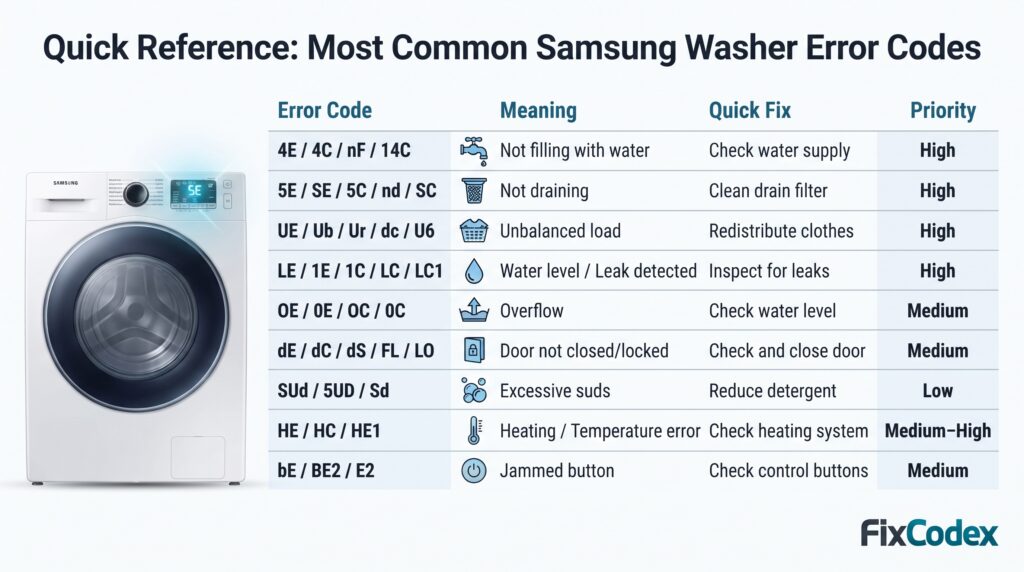
| Error Code | Meaning | Quick Fix Priority |
|---|---|---|
| 4E / 4C / nF / 14C | Not filling with water | High – Check supply |
| 5E / SE / 5C / nd / SC | Not draining | High – Clean filter |
| UE / Ub / Ur / dc / U6 | Unbalanced load | High – Redistribute |
| LE / 1E / 1C / LC / LC1 | Water level / Leak detected | High – Inspect leaks |
| OE / 0E / OC / 0C | Overflow | Medium |
| dE / dC / dS / FL / LO | Door not closed/locked | Medium |
| SUd / 5UD / Sd | Excessive suds | Low – Detergent issue |
| HE / HC / HE1 | Heating / Temperature error | Medium–High |
| bE / BE2 / E2 | Jammed button | Medium |
Detailed Samsung Washer Error Codes & Troubleshooting
1. Water Supply / Not Filling Errors (4E, 4C, nF, 14C, nF1, 4C2, 4E2)
The washer is not receiving water properly or detects incorrect temperature.
What to do:
- Confirm both hot and cold water valves are fully open.
- Check that supply hoses are not kinked or bent. Do not use Flood Safe hoses.
- Ensure hot is connected to hot and cold to cold (blue to blue, red to red). Swapped hoses often cause 4C2 / 4E2 / nF1.
- Clean the inlet mesh filters: Turn off water, disconnect hoses from the back of the washer, and remove debris from the screens.
- Make sure the drain hose is inserted no more than 6 inches into the standpipe and is not kinked.
- Power cycle the washer (unplug or breaker off for 1 minute).
If the code persists after cleaning filters and checking connections, the inlet valve or sensor may need service.
2. Drain Errors (5E, SE, 5C, nd, SC)
Water is not draining at the correct speed or at all.
What to do:
- Inspect the drain hose for kinks, clogs, or improper height (ideally 60–90 cm / 24–36 inches).
- Clean the pump filter (front-load models): Locate the access panel at the bottom front, place a towel and shallow pan underneath, open the filter cover, and remove lint, coins, or debris. Run a short drain cycle afterward.
- Ensure the drain hose is not pushed too far into the standpipe.
- Power cycle and restart the cycle.
Persistent codes often point to a failing drain pump.
3. Unbalanced Load Errors (UE, Ub, Ur, dc, U6, 1Ub)
The load is uneven, preventing a safe high-speed spin. “Ur” usually means the washer is retrying by adding water.
What to do:
- Pause or stop the cycle.
- Open the door/lid and redistribute clothes evenly. Avoid washing a single heavy item (blanket, rug, or jeans alone).
- Add a few similar items if the load is too small or light.
- Make sure the washer is level on a solid floor.
- Restart the cycle (or select Spin only).
This is one of the most common codes and almost always fixed by rearranging the load.
4. Water Level / Leak Errors (1E, LE, 1C, LC, LC1)
Moisture is detected where it shouldn’t be, or the water level sensor has an issue.
What to do:
- Look carefully under and behind the washer for leaks (even small ones).
- Check supply and drain hoses for kinks or loose connections. Do not remove the screw holding the drain hose against the back of the machine.
- Run empty cycles with no detergent to clear excess suds (common cause of false leak detection).
- If no visible leak or suds, power cycle the machine.
Continued codes usually require professional service for the sensor or a real leak.
5. Overflow Errors (OE, 0E, OC, 0C)
Too much water is detected in the tub.
What to do:
- Turn off the water supply immediately.
- Check for a stuck-open inlet valve or clogged drain preventing proper water exit.
- Verify you are using the correct amount of HE (High Efficiency) detergent.
- Power cycle and restart.
6. Door / Lid Errors (dE, dE1, dE2, dC, dS, FL, LO, dL, SDC)
The door is not detected as properly closed and locked.
What to do:
- Make sure nothing (clothing, socks, etc.) is caught in the door seal or latch.
- Close the door firmly until it clicks.
- On models with Child Lock, disable it if needed.
- Check for damage to the latch or door boot.
Some models (e.g., FlexWash) may show specific codes if a rubber button near the upper washer latch is missing.
7. Excessive Suds (SUd, 5UD, Sd, SUdS)
Too many suds detected. The washer pauses to let them dissipate.
What to do:
- Use only HE detergent and the correct amount (usually much less than regular detergent).
- Run extra rinse cycles or empty cycles until suds clear.
- This is not a machine failure—it is almost always user-related detergent overuse.
8. Other Notable Codes
- bE / BE2 / E2 / 6E2 — Jammed button: Power off and firmly press every button on the control panel several times.
- HE / HC / HE1 / Hr — Heating error: Usually a failed heating element or temperature sensor (front-load models). Professional service often needed.
- 3E / 3C — Motor-related (or voltage on some models): Power cycle first; persistent issues need service.
- PF / 9C1 / UC — Power/voltage irregularity: Ensure the washer is on a dedicated circuit with no extension cord. Check for recent power outages.
- CL — Child Lock is active (or activated drainage safety).
- dn — Downloading a software update (keep powered on; usually takes ~15 minutes).
- Cb / C6 — Calibration mode: Run only with an empty tub.
All Other Errors (AE, AC, tE, 8E, BE, PC, IE, SF, etc.)
These usually indicate sensor, communication, or electronic issues. Power the washer off for 2–3 minutes, then restart. If the code returns, contact Samsung Support or a qualified technician.
Pro Tips to Prevent Samsung Washer Error Codes
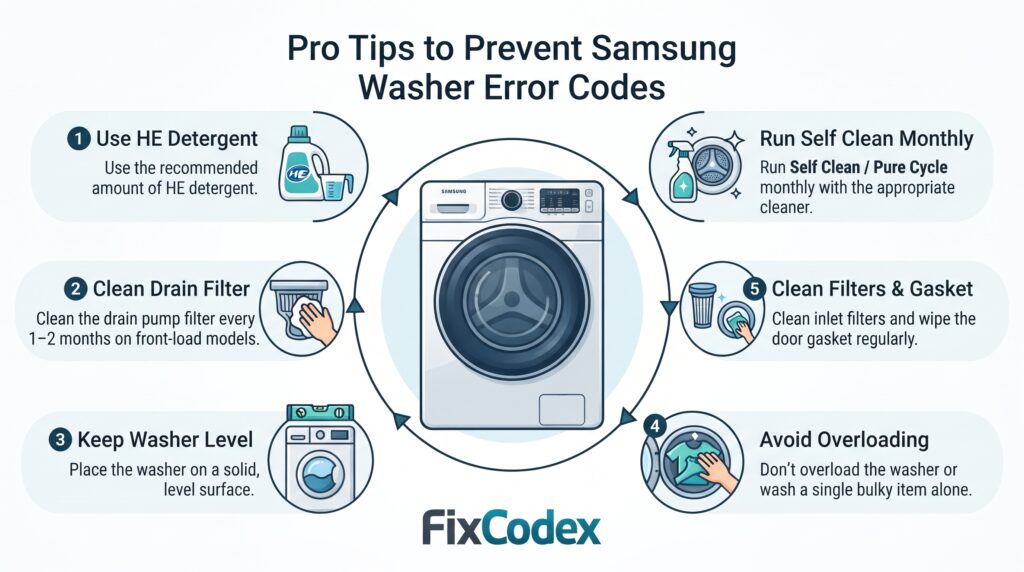
- Always use HE detergent in the recommended amount.
- Clean the drain pump filter every 1–2 months (front-load).
- Keep the washer level and on a solid surface.
- Avoid overloading or washing single bulky items alone.
- Periodically clean inlet filters and wipe the door gasket.
- Run a Self Clean / Pure Cycle monthly with the appropriate cleaner.
When to Call for Service
Contact Samsung Support or a certified technician if:
- The same code returns after proper troubleshooting.
- You see water leaking from under the machine.
- There are unusual noises, burning smells, or the machine will not power on.
- Codes related to motor, heater, sensors, or communication appear repeatedly.
For model-specific instructions, download your user manual from Samsung’s support site or visit the official error code page for the most current information.
Samsung Washer Error Codes — 10 Common Q&As
1. What does a Samsung washer error code mean?
A Samsung washer error code indicates a problem the machine has detected. The code helps you identify where to start troubleshooting.
2. What does 4E or 4C mean on a Samsung washer?
4E/4C usually indicates a water supply or filling problem. Check that the water taps are fully open and the inlet hoses are not kinked or blocked.
3. What does 5E or 5C mean on a Samsung washer?
5E/5C usually indicates a draining problem. Check the drain hose and clean the drain filter if your model has one.
4. What does UE or Ub mean on a Samsung washer?
UE/Ub indicates an unbalanced load. Pause the washer, redistribute the clothes evenly, and restart the cycle.
5. What does LE or LC mean on a Samsung washer?
LE/LC can indicate a water-level or leak-related problem, depending on the model. Check for visible leaks and refer to your model’s manual for the exact meaning.
6. What does dE or dC mean on a Samsung washer?
dE/dC generally indicates a door problem. Make sure the door is completely closed and that no clothing is trapped around the door seal.
7. What does Sud or 5UD mean on a Samsung washer?
Sud/5UD indicates excessive suds. Using too much detergent or the wrong type of detergent can cause this problem. Use the recommended amount of HE detergent.
8. What does HE or HC mean on a Samsung washer?
HE/HC generally relates to a heating or temperature problem. If the code remains after restarting the washer, further inspection may be needed.
9. How do I reset a Samsung washing machine after an error code?
Turn the washer off and unplug it for about 1–2 minutes, then reconnect it and restart the cycle. If the error returns, check the specific code and your model’s user manual.
10. Can I fix Samsung washer error codes myself?
Many common errors can be resolved with simple checks, such as water supply, drain hoses, filters, load balance, door closure, and detergent use. If the code continues or involves an electrical, heating, or internal component problem, professional service may be needed.
Related searches people also make:
Samsung washer 4E error fix • Samsung 5E drain filter cleaning • UE unbalanced load Samsung • Samsung LE leak error • How to reset Samsung washing machine error codes
This guide helps you quickly diagnose and resolve the majority of Samsung washer error codes so you can get back to clean laundry with minimal downtime.
For more information about Samsung washing machine error codes, please visit Samsung website.
For error codes from other washer brands, click “Washer Error Codes” here.